


1
The first cities report from the Lancet Countdown Europe tracks progress on health and climate change for European cities.
Compiled with the contribution of 58 experts spanning 31 academic institutions, the new report explores 28 indicators which monitor the health impacts of climate change across five domains.
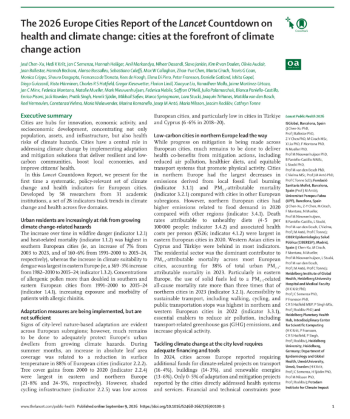
Explore key findings of this year’s Europe cities report
The 2026 Europe cities report of the Lancet Countdown on health and climate change: narrowing window for decisive health action
HEALTH HAZARDS, EXPOSURES, AND IMPACTS
A changing climate has profound implications for human health, with more frequent heat waves and extreme weather events, changing patterns of infectious disease transmission, deterioration of food and water resources, impacts on socioeconomic conditions, and the exacerbation of existing health challenges around the world. Indicators in this section track the multiple ways in which climate change threatens human health and wellbeing.
1.1.2 Heat related mortality
Heat related mortality had the largest increases in Southern European cities with a 160.6% increase from 1991-2000 to 2015-2024.
1.2.1 Wildfire smoke
Wildfire danger had the largest increases of 7% in southern European cities, from 2003-2023.
1.4.1 Allergenic trees
Concentrations of allergenic pollen have more than doubled in southern and eastern European cities from 1991-2000 to 2015-2024, increasing exposure to people with allergic rhinitis.
ADAPTATION, PLANNING, AND RESILIENCE FOR HEALTH
With climate change increasingly threatening the health and wellbeing of populations in every country, actions to build resilience and adapt to climate change are urgently needed. This section tracks how communities, health systems, and governments are understanding the health risks of climate change, the strategies and resources they are deploying, and how adaptation and resilience measures are being implemented.
2.2.2 Surface urban heat island adaptation, green lead area coverage, and albedo effect
There was an average temperature reduction of 0.7°C in surface urban heat island intensity during summer months from 2014-2019 across all European cities.
2.2.4 Urban tree cover
Tree cover gains from 2000-2020 were largest in eastern Europe (21.8%) and northern Europe (24.5%).
2.2.5 Heat-resilient cycling infrastructure
Shaded cycling infrastructure was low across European cities, being exceptionally low in cities in Türkiye and Cyprus, with a tree coverage of 6.6% of cycling lanes in 2018-2020.
MITIGATION ACTIONS AND HEALTH CO-BENEFITS
Reducing greenhouse gas emissions is essential to limit the health threats of climate change. Simultaneously, many of the interventions required to mitigate and adapt bring enormous co-benefits for human health and wellbeing in the form of cleaner air, healthier diets, and more liveable cities. Tackling climate change could be the greatest global health opportunity of the 21st century. Indicators in this section track the world’s efforts to mitigate climate change, and the effective and the health co-benefits of this response.
3.1.2 Mortality attributable to ambient fine particles
The residential sector was the dominant contributor to PM2·5-attributable mortality in cities, accounting for 38% of total PM2·5-attributable mortality in 2023.
3.2.1 Mortality attributable to ambient fine particles
Solid fuels in eastern European cities led to a PM25-related all-cause mortality rate more than three times that of northern cities in 2023.
3.5 City-level climate change mitigation targets and actions
From the 1,967 mitigation actions identified by cities, 42.1% mentioned at least one health co-benefit.
ECONOMICS AND FINANCE
The health impacts of climate change have profound economic implications. This section tracks the economic costs of the health impacts of climate change and its drivers, as well as the extent to which the world’s economy and financial systems are enabling the transition to a health-promoting, zero-carbon economy.
4.2.1 City-level climate action funding
Cities reported needing additional funds for climate projects on transport (16.4%), buildings (14.3%), and renewable energy (13.6%).
4.2.1 City-level climate action funding
Only 0.5% of adaptation and mitigation projects reported by cities directly addressed health systems and services.
4.2.1 City-level climate action funding
In 2024, cities reported funding for 94.5% of 1,519 adaptation actions and 63.3% of 1,967 mitigation actions.
PUBLIC AND POLITICAL ENGAGEMENT
Public and political engagement underpins the foundations of the world’s collective response to climate change, with reductions in global emissions at the speed required by the Paris Agreement depending on engagement from all sectors of society. This working group tracks key actors’ engagement with the links between health and climate change, including in the media, national governments, the corporate sector, and the broader public.The indicators in this section track the links between health and climate change in the media, national governments, the corporate sector, and the broader public.
5.4.1 Coverage of health and climate change in urban areas across online newspaper articles
Nearly one quarter of online newspaper articles on climate change addressed health issues at the urban level between 2023 and 2025.
5.4.1 Coverage of health and climate change in urban areas across online newspaper articles
Health-related coverage in online newspaper articles followed a clear seasonal patter, with more references to health peaking in the summer and dropping to the lowest in winter.

Dr José Chen, Research Fellow and lead author, Lancet Countdown Europe
“This year’s heatwaves and wildfires are not isolated disasters – they are symptoms of a warming climate that is loading the dice for more frequent and more dangerous extremes. Across Europe, people can feel these changes in their daily lives. We have the data to help highlight where the risks are greatest and why urgent action is needed to protect people’s health.”

Professor Cathryn Tonne,
Co-Director, Lancet Countdown Europe
“Cities have a unique opportunity to deliver healthier, more sustainable and more resilient futures for their residents. We must harness their ambition and ensure cities are equipped to protect health and wellbeing of populations across Europe.”
Explore our sub-national data sheets
Read our sub-national data for Bulgaria, France, Ireland, Spain, Sweden and the UK.
Translated Press Release and Executive Summaries available to download
Read our Executive Summary in Spanish and French translations.
Watch the Europe
report launch event
Featuring expert and passionate speakers on health and climate change